Science
Science at Templars: Curious Thinkers, Confident Investigators, Future Innovators
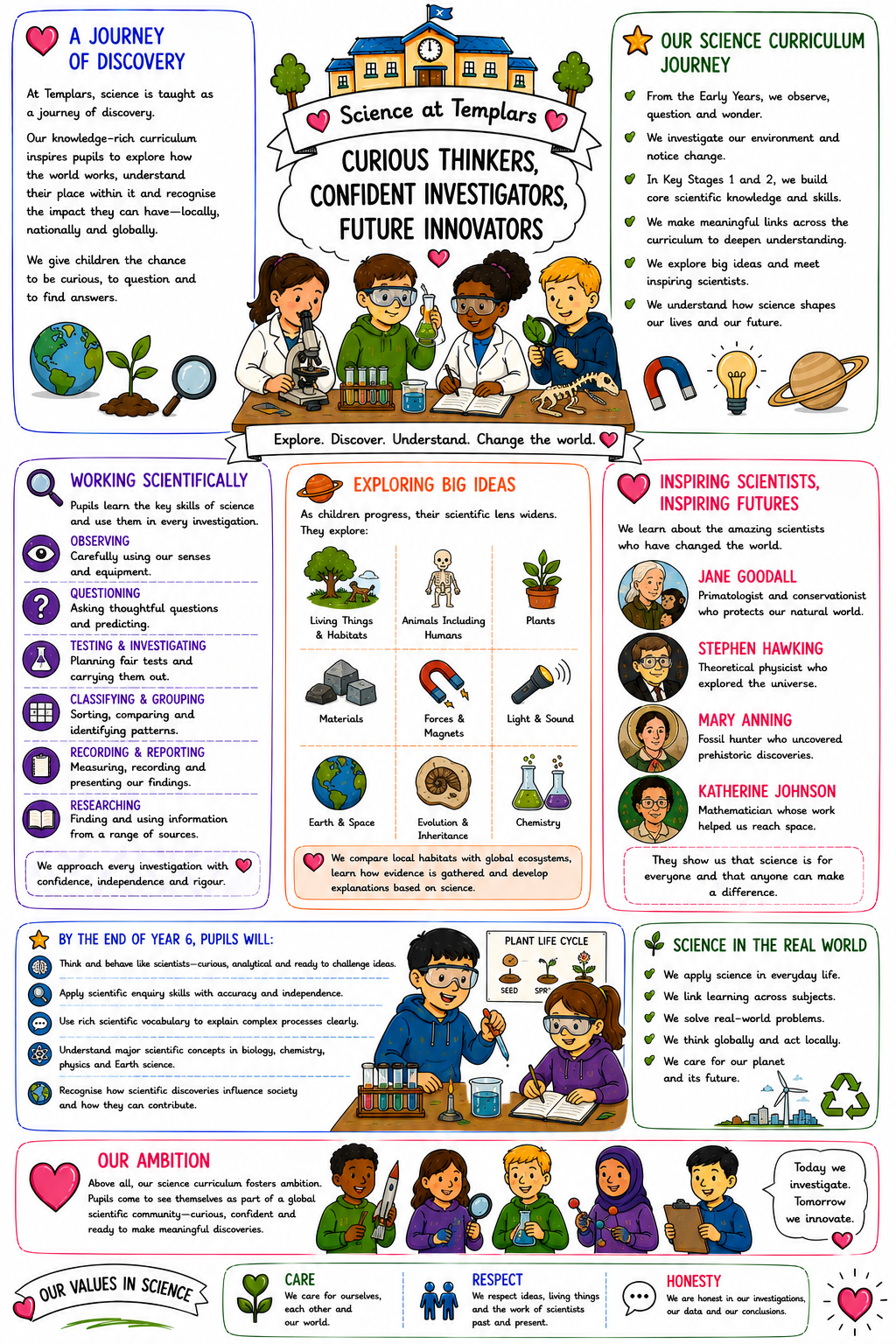
At Templars, science is taught as a journey of discovery. Our knowledge-rich curriculum inspires pupils to explore how the world works, understand their place within it and recognise the impact they can have—locally, nationally and globally.
From the Early Years onward, children learn to observe, question and wonder. They investigate their immediate environment, notice change and begin to ask the “why” behind what they see. This early curiosity becomes the foundation for increasingly sophisticated scientific thinking.
Across Key Stages 1 and 2, pupils are explicitly taught the core skills of working scientifically—observing, testing, classifying, researching and recording. These skills equip them to approach every investigation with confidence, independence and rigour. As their knowledge grows, pupils make meaningful links between scientific ideas and the wider curriculum, deepening their understanding of how science shapes everyday life.
As children progress through school, their scientific lens widens:
-
They compare local habitats with ecosystems around the world.
-
They explore forces, materials, space, evolution and the Earth’s processes.
-
They learn how evidence is gathered, questioned and used to develop scientific explanations.
-
They meet key scientists—past and present—whose work has changed how we live, helping them see science as a diverse, dynamic and evolving discipline.
By the end of Year 6, pupils leave Templars equipped to:
-
Think and behave like scientists—curious, analytical and ready to challenge ideas.
-
Apply scientific enquiry skills with accuracy and independence.
-
Use rich scientific vocabulary to explain complex processes clearly.
-
Understand major scientific concepts in biology, chemistry, physics and Earth science.
-
Recognise how scientific discoveries influence society and how they, too, can contribute.
Above all, our science curriculum fosters ambition. Pupils come to see themselves as part of a global scientific community—with the confidence to investigate, the curiosity to keep asking questions and the belief that they can make meaningful discoveries of their own.